Course: Citizenship and National Identity
Module 4: Citizenship & Birth Registration
This module examines how citizenship deprivation affects children and the importance of birth registration for recognition and access to basic rights.
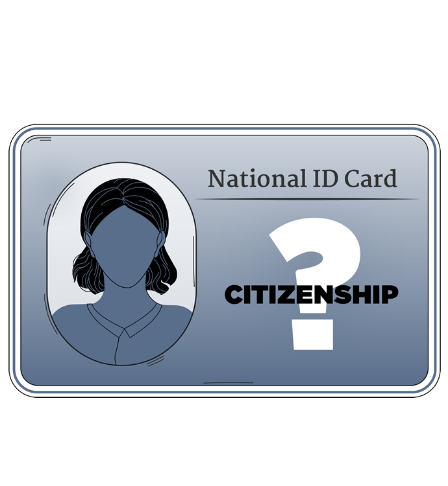
Children are particularly at risk under exclusionary citizenship policies. This module examines how citizenship, or the lack of it, impacts a child’s life both in a national and international context. It will specifically focus on the importance of birth registration and its connection to legal identity and access to basic rights.
Birth Registration
A birth certificate is the first official document a child receives after birth. It plays a key role in shaping the child’s identity. Without birth registration, a child lacks legal status in the eyes of the State and, for all practical purposes, may be considered invisible and unprotected.
Case Presentation: Birth Registration Challenges for Rohingya Children
Rohingya children are often denied birth certificates by Myanmar authorities, with their births recorded only in household lists. Those born in refugee camps or temporary accommodations in countries like Bangladesh and Thailand are typically unregistered and lack legal identity or refugee status. As a result, they face double marginalization, excluded from both Myanmar and their host countries.
In Myanmar, acquiring citizenship has been particularly challenging for ethnic minorities such as the Rohingya, Kachin, and Karen. Even when they meet the formal criteria, they are often denied the essential documentation required to obtain citizenship due to complex administrative procedures.
To obtain a national ID card, individuals must present a range of documents, including their original household registration list, a completed family tree covering three generations, and an original birth certificate. The possession of a national ID card is, in fact, the only proof of full citizenship in Myanmar.
Obtaining a birth certificate requires parental ID information. If the parents lack national ID documents, rendering them stateless, their children are automatically stateless as well. For instance, many Karen remain stateless despite being listed as a national race, as they are unable to secure a national ID card and consequently pass on this statelessness to subsequent generations.
Birth Registration Barriers in Refugee Camps
Article 7 of the CRC emphasizes that children must be registered immediately after birth and have the right to a name and acquire a nationality, as well as, as far as possible, the right to know and be cared for by their parents. It also obliges states to ensure these rights, especially in cases where a child might otherwise be stateless.
Article 24 of the ICCPR echoes these rights, highlighting that every child, without discrimination, must be registered at birth, have a name, and the right to acquire a nationality. It also underlines the duty of the family, society, and the State to offer protection appropriate to the child’s status as a minor.
Link between Birth Registration and Citizenship
Birth registration plays a crucial role in securing a child’s right to identity, citizenship, and legal protection. It documents essential information such as the child’s name, place of birth, and parentage. Birth registration is directly tied to the process of obtaining citizenship.
Citizenship Deprivation: Effects Across Generation
For those who live without a recognized nationality, the consequences extend beyond individual hardships, impacting entire communities and creating a cycle of exclusion, deprivation, and discrimination across generations.
For instance, the Rohingya have faced systemic exclusion and persecution for decades. Unable to prove citizenship due to insufficient documentation and arbitrary administrative decisions, Rohingyas are one of the largest stateless populations in the world. The lack of birth registration for Rohingya children reinforces their statelessness, preventing access to basic rights such as education, healthcare, and legal protection. Children born without legal identity face compounded vulnerability, perpetuating exclusion across generations.
Similarly, many Bengali-speaking Muslims in Assam, India, have been excluded from the NRC list or declared foreigners due to inadequate documentation and arbitrary decisions by the Foreigners Tribunals. The potential consequences of statelessness, particularly for the Bengali-speaking Muslims as discussed in Modules 2 & 3, are severe, affecting not only the individuals directly involved but also their children. The inability to register births or prove the legal status of a parent often means that children inherit the same stateless status, perpetuating a cycle of exclusion. According to India’s citizenship legislation, a child born in India cannot acquire citizenship if one of the parents is an illegal migrant (Article 3, Indian Citizenship Amendment Act, 2003). Though the situation in Assam may not yet be as dire as that of the Rohingyas, it presents a growing risk, especially for children, who may inherit their parents’ statelessness.
In both cases, the intergenerational consequences are clear, without citizenship or birth registration, children are trapped in a cycle of marginalization and exclusion, leading to a lifetime of limited opportunities and human rights violations. Statelessness becomes a cycle, passed from one generation to the next, undermining access to education, healthcare, and legal protections.
Effects on Fundamental Human Rights
The absence of birth registration not only affects an individual’s right to acquire citizenship. It also has a significant impact on their ability to enjoy other essential rights, including access to healthcare, education, employment, legally recognized marriage, inheritance, voting rights, and freedom of movement. Children without birth registration, in particular, are often denied education and healthcare, which can have serious long-term consequences for both the individuals and the community at large.
Article 3(1) of CRC: In all actions concerning children, whether undertaken by public or private social welfare institutions, courts of law, administrative authorities or legislative bodies, the best interests of the child shall be a primary consideration.
Additional Resources
- Petrozziello, Allison J. 2024. Gaps and Challenges for Ensuring Universal Birth Registration for Children Born to Migrants and Multiply Marginalized Mothers (https://www.ohchr.org/sites/default/files/documents/issues/digitalage/cfis/birth- registration/subm-universal-birth-registration-aca-dr-allison-petrozziello-toronto-metro- pdf)
- UN High Commissioner for Refugees (UNHCR),Good Practices Paper – Action 2: Ensuring that no child is born stateless, 20 March 2017, https://www.refworld.org/policy/opguidance/unhcr/2017/en/121326
- Groot, Gerard-René de. “Children, Their Right to a Nationality and Child Statelessness” Chapter 6 in Nationality and Statelessness under International law, 144-68. Cambridge: Cambridge University Press, 2014
- Ziemele, Ineta. 2007. The Right to Birth Registration, Name and Nationality, and the Right to Know and Be Cared for by Parents. Commentary on the United Nations Convention on the Rights of the Child 7. Leiden: Nijhoff.
- UN Human Rights Council, Birth registration and the right of everyone to recognition everywhere as a person before the law, 17 June 2014, A/HRC/27/22, available at: https://undocs.org/A/HRC/27/22 [accessed 05 November 2021]
- UN Human Rights Committee (HRC), CCPR General Comment No. 17: Article 24 (Rights of the Child), 7 April 1989, available at: https://www.refworld.org/docid/45139b464.html
Questions for reflection and discussion
- Do you think that the lack of birth registration is an early indicator of a child’s increased vulnerability and marginalization? If so, how?
- What responsibilities do States have to ensure that every child is registered at birth?
- In the context of the Rohingyas and Bengali-speaking Muslims, do you observe state-led actions that could prevent children from acquiring nationality and other fundamental rights? (Reflect on the insights gained from all four modules.)
Excercise
Case: The Yean and Bosico v. Dominican Republic case (2005) involved two girls of Haitian descent born in Dominican Republic, were denied Dominican nationality and birth certificates, leaving them stateless. The Inter-American Court ruled that this violated their rights to nationality, equality, and special protection as children, setting a landmark precedent against discrimination and statelessness.
Guiding questions:
- Which human rights were violated in this case?
- Why is the right to nationality considered fundamental to accessing other rights?
- How did the denial of birth certificates contribute to the girls becoming stateless?
- In what ways did racial or ethnic discrimination play a role in this case?
- What measures would you put in place to prevent similar violations?
Activity (group discussion):
- Compare this case with situations in your own country or region.
- Identify key lessons from the case that could apply to strengthening citizenship, identity, or protection against statelessness locally.
You have reached the end of the course Citizenship & National Identity.
Congratulations on completing this online course!
We appreciate your time, effort, and dedication throughout the course. We hope the knowledge and insights you have gained will continue to inspire and guide you in both your work and personal growth. Thank you for being part of this journey, and we look forward to your future endeavours in promoting inclusive citizenship and upholding human rights.
We also extend our gratitude to our regional partners and all other contributors for their invaluable support in developing this course. This course was developed in collaboration with Parichay and with the support of external experts such as Fernand de Varennes. We also thank the Norwegian Agency for Development Cooperation (NORAD) for their financial support.
The editorial team –
Neha Philip (main editor), Shardul Gopujkar, Fahmina Karim, Darshana Mitra, Ingvill T. Plesner, Andrea Cocciarelli, Sidsel Wiborg